
Material fundamentals · Mass and volume
Density and the weight of a blank
Is a lighter blank necessarily made of lighter wood?
Density separates the amount of material from the size of the blank. It is the starting point for comparing mass, stiffness per unit mass and several acoustic indices.
Try the interactive demoStart with something familiar
A large empty box can weigh less than a small solid block. Weight alone mixes together two questions: how much space is occupied, and how much mass that space contains. Density separates them.
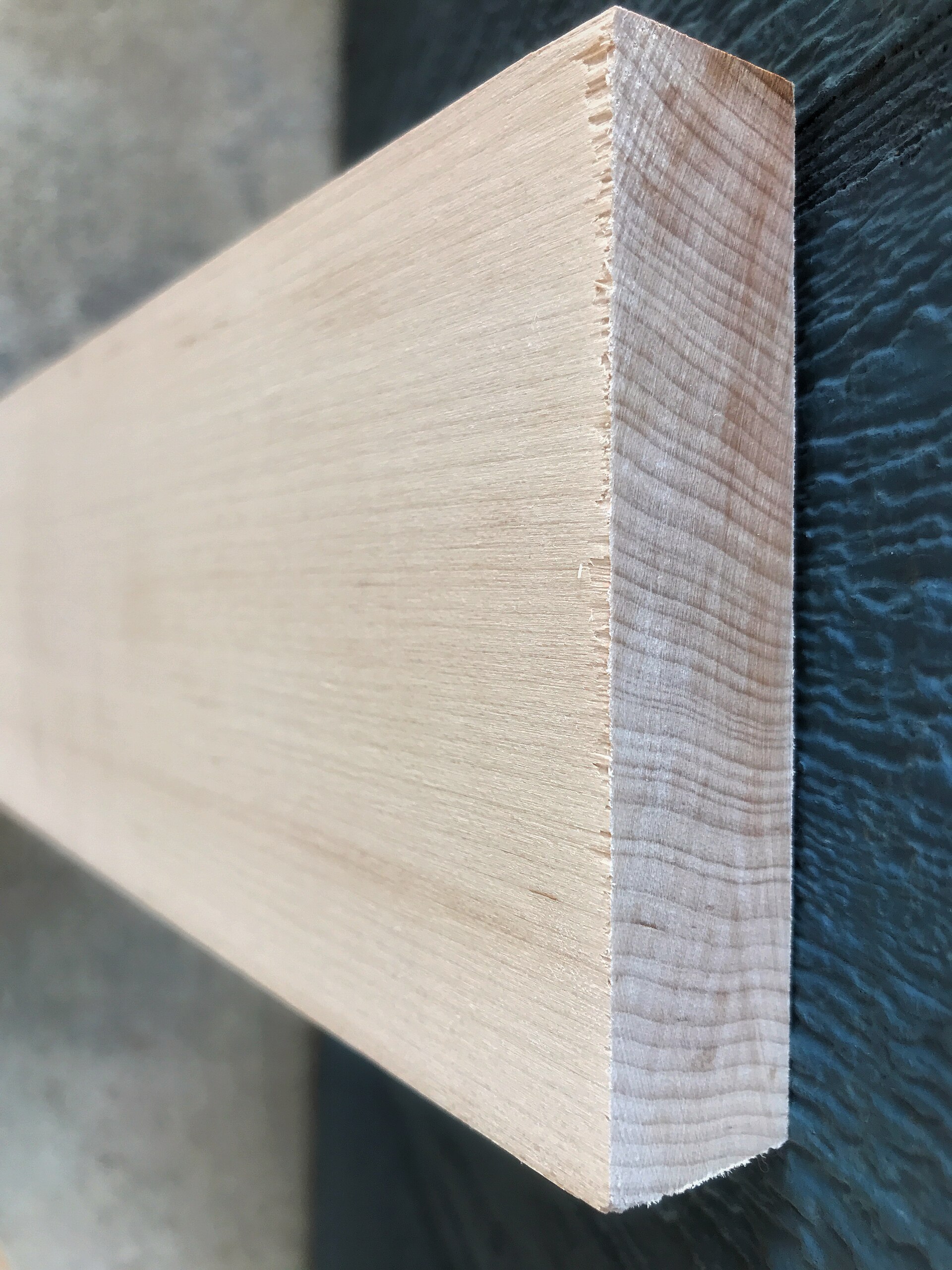
Connect the diagram to a real object
The end grain and broad face belong to the same sugar maple blank. Density compares mass with volume: the photograph shows the geometry, while weighing and dimensions supply the measurement.
Stephen Ondich · Wikimedia Commons · CC BY-SA 3.0
Article photographs retain their full proportions; covers show a cropped view.
ρ = 400 kg/m³
Same volume; different mass
ρ = 600 kg/m³
Same volume; different mass
Notice what changes
Compare equal volumes first. If equally sized pieces weigh differently, the heavier one has greater density in its current condition.
Understand why
For unequal blanks, divide mass by volume. A small blank may be light only because less material is present, not because its wood is intrinsically low-density.
Connect it to wood and making
In a fixed plate geometry, lower density means lower mass. Once thickness or arching changes, however, the final mass changes too. Density is one part of the maker’s material budget.
Put names to the ideas
Mass per unit volume
Density ρ = m/V has SI units kg/m³. A small, dense block may weigh less than a large, low-density block. Always compare volume as well as mass.
State the moisture basis
Current density, oven-dry density and basic density use different mass or volume conditions. Do not mix these definitions in one comparison or silently treat an air-dry reading as oven-dry density.
Geometry determines the estimate
For a rectangular blank V = Lbh. A linear wedge uses the mean of its two thicknesses; an irregular carved plate needs a suitable volume method rather than its bounding box.
ρ = m/V reads “mass in each unit of volume.” One kg/m³ means one kilogram spread through one cubic metre. The Greek letter ρ is just the conventional name for density.
A worked example
A 400 × 40 × 10 mm strip occupies 0.00016 m³. At 64 g its density is 400 kg/m³. Entering millimetres as metres would change the result by a billion, so retain the original units with the record.
Explore it yourself
Measure several thickness locations, record the geometry and moisture state, and calculate volume before comparing blanks.
- c
- 5345 m/s
- E′/ρ
- 28.57 10⁶ m²/s²
- R
- 12.73 m⁴/(kg·s)
- Z
- 2.24 MRayl
- Q ≈ 1/η
- 100.0
- ACE
- 1273 m⁴/(kg·s)
E′ + ρ → c → R, Z η → Q → ACE