
Measurement methods · Reliability
Uncertainty and thickness sensitivity
Why can a tiny thickness error move the modulus so much?
The powers in an inversion formula amplify some reading errors more than others. Repeatability, instrument accuracy and model error must be considered separately.
Try the interactive demoStart with something familiar
A recipe using a cubed ingredient ratio is more sensitive than one using it once. In beam inversion, thickness appears three times as a factor, so a small reading bias can have a noticeably larger effect on E′.
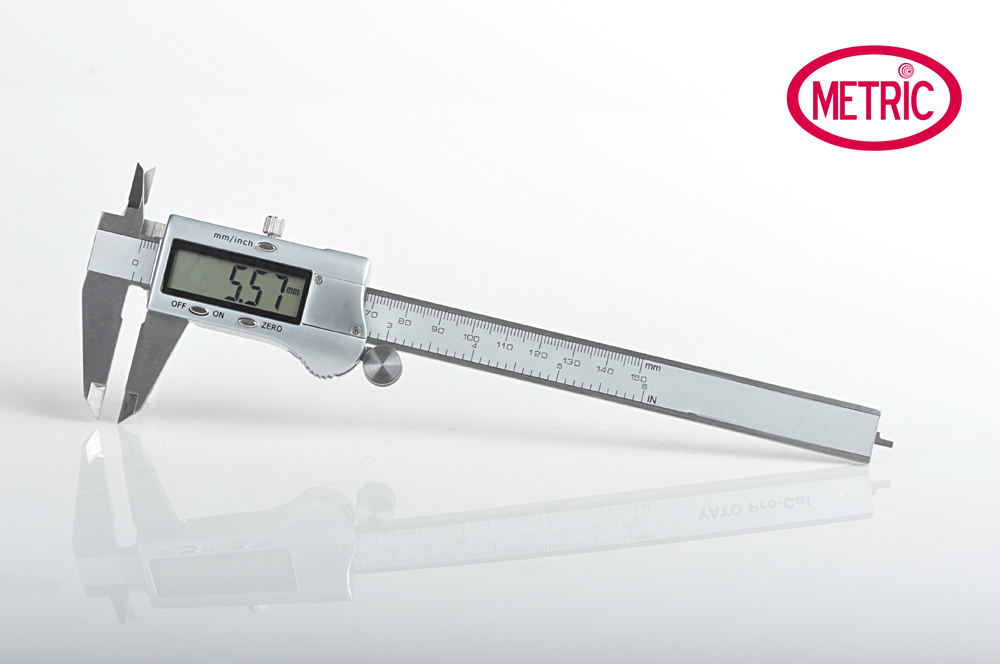
Connect the diagram to a real object
A digital caliper makes dimensions readable, but the last displayed digit is not a guarantee of accuracy. Zero setting, contact position and repeated readings belong in the measurement record.
Lior Streng · Wikimedia Commons · CC BY-SA 4.0
Article photographs retain their full proportions; covers show a cropped view.
Reading high by 1%
First-order effect on inferred E′
Repeatability ≠ no bias
A shifted cluster can still be tightly grouped
Notice what changes
Keep the true teaching specimen fixed and change only the entered reading. This is a reading-error experiment, not a simulation of physically carving the specimen thinner.
Understand why
A high thickness reading puts a larger number in the denominator and lowers inferred E′. A high frequency reading increases the squared numerator and raises inferred E′.
Connect it to wood and making
Repeated taps reveal scatter, not every bias. A wrong thickness map, unit conversion or mode can consistently give the same wrong answer. Repetition and validity are different checks.
Put names to the ideas
Inspect the exponents
For the fixed-mass rectangular-strip inversion, E′ is proportional to mf²L³/(bh³). A small +1% thickness reading error alone gives roughly −3% modulus error to first order.
Bias does not average away
Repeated taps can reveal frequency scatter but cannot correct a miscalibrated caliper or systematically wrong thickness definition. Record instruments and sampling locations.
Dependencies affect propagation
If density is itself calculated from the same dimensions and mass, it is not an independent error input. Adding separate “density uncertainty” would double-count some contributions.
The numbers 1, 2, 3, −1 and −3 are local sensitivity weights for small reading changes. This signed approximation is not a ready-made statistical confidence interval.
A worked example
Keeping all other readings fixed, +1% thickness yields the exact factor 1/1.01³ ≈ 0.9706. The differential estimate −3% is close, but is not an uncertainty confidence interval.
Explore it yourself
Use the strip calculator to perturb readings individually. For real work, report repeat ranges and model assumptions instead of only additional decimal places.
- ρ
- 400.0 kg/m³
- E′
- 12.00 GPa
- Density deviation
- 0.00%
- Modulus deviation
- 0.00%
Baseline: 400 × 40 × 10 mm, 64 g, 351.88 Hz. Only a uniform slender strip; changes represent reading errors, not a carved plate.