
Material fundamentals · Environment
Moisture content and conditioning
Why can the same piece measure differently next week?
Water changes mass, dimensions and mechanical response. A useful measurement describes the wood and its condition. Equal room humidity does not guarantee equal wood moisture content.
Try the interactive demoStart with something familiar
A dry towel weighs more after it takes up water. Wood also exchanges moisture with the air, although its dimensions and mechanical response change as well. A moisture number needs a clearly stated denominator.
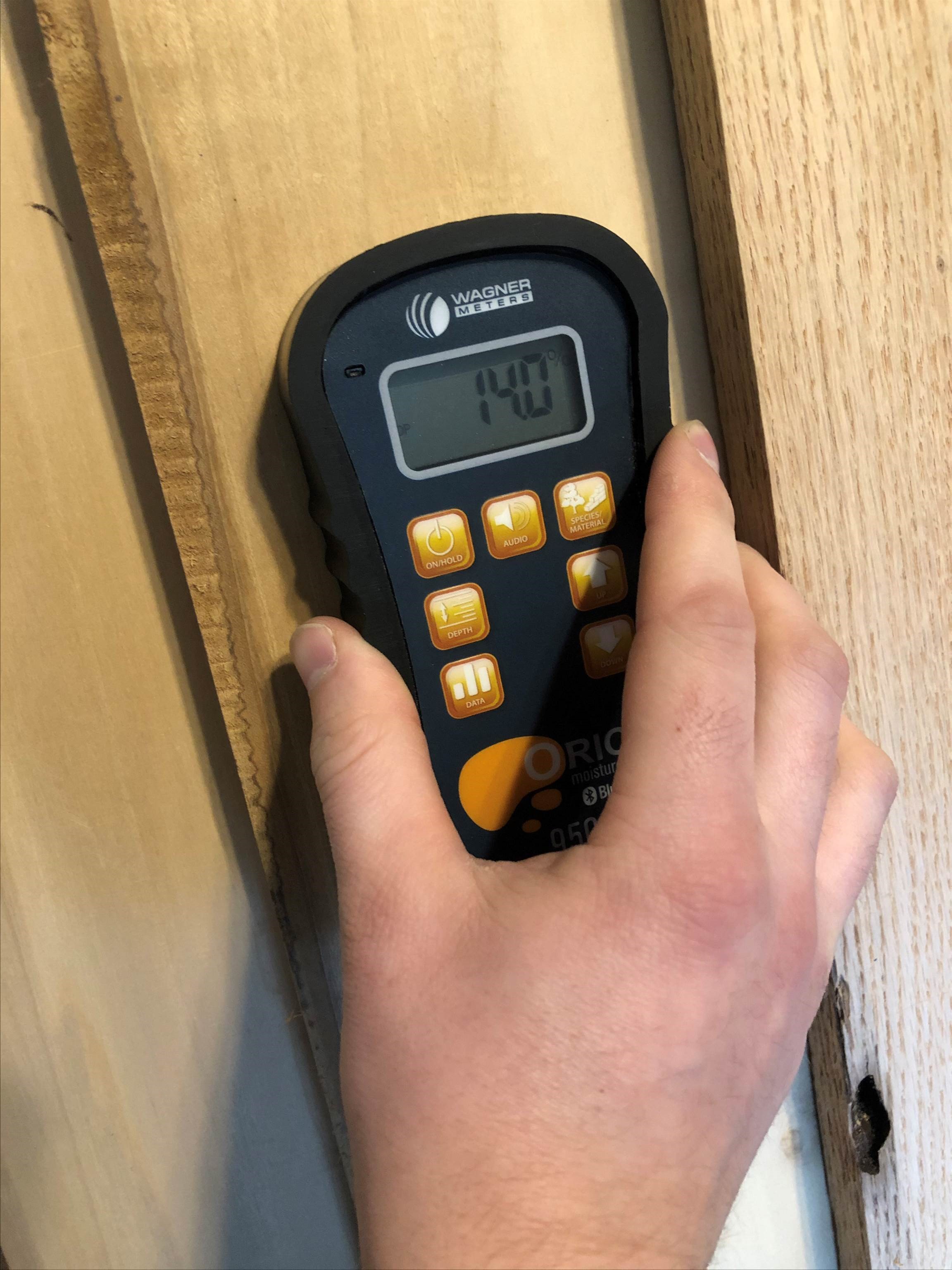
Connect the diagram to a real object
A real example of an electronic moisture reading. The instrument estimates the wood’s moisture state, not the room’s relative humidity. Calibration and measurement conditions still matter; this photo is not a product endorsement.
Hrco · Wikimedia Commons · CC BY-SA 4.0
Article photographs retain their full proportions; covers show a cropped view.
Dry wood · 100 g
Dry wood is the reference mass
Current mass · 112 g
12 g water / 100 g dry wood = 12%
Notice what changes
Imagine separating dry wood from its water. Wood moisture content compares the added water mass with the oven-dry wood mass, not with the total current mass.
Understand why
Air humidity describes the surroundings, and a thick blank cannot respond instantly. Even at equilibrium, drying and moisture uptake can give different wood moisture contents at the same temperature and humidity: this is sorption hysteresis.
Connect it to wood and making
For comparisons, record temperature, relative humidity, conditioning duration and whether the wood was absorbing or losing moisture. Keep both test records; a difference does not automatically make the earlier measurement wrong.
Put names to the ideas
Dry mass is the denominator
Moisture content is water mass divided by oven-dry wood mass, expressed as a percentage. It is not water mass divided by the current wet mass.
Relative humidity is different
Air relative humidity describes the environment. Wood approaches an equilibrium moisture content over time; temperature, specimen size and moisture history affect that process.
Sorption hysteresis: the path matters
At the same temperature and relative humidity, equilibrium moisture content depends on moisture history. Desorption from a wetter state generally gives a higher value than absorption from a drier state. This sorption hysteresis differs from the time needed for moisture to move through a thick blank.
m₀ is dry wood mass, m − m₀ is water mass. A 100 g dry sample plus 12 g water has 12% wood moisture content, although water is only about 10.7% of the 112 g total.
A worked example
A sample with 100 g oven-dry mass weighs 112 g at 12% moisture content. The calculator changes water mass only; it does not pretend that modulus, dimensions or damping stay constant in real wood.
Explore it yourself
Change dry mass and moisture content to inspect the mass balance. For comparisons, record temperature, relative humidity, conditioning duration and whether the blank was absorbing or losing moisture; repeat measurements under stable conditions. Record moisture-meter calibration, method and locations. Routine comparative recording does not require oven drying a valuable instrument blank.
- Water mass
- 12.00 g
- Current mass
- 112.00 g
Water is 10.7% of current mass. That percentage differs from wood moisture content.