
Violin making · Material and geometry
Thickness, arching and modal frequency
Why does thinning change both mass and stiffness?
Geometry translates material properties into a structural response. A simple strip explains the strong role of thickness, while an arched orthotropic plate needs a richer model.
Try the interactive demoStart with something familiar
A thin ruler bends more easily than a thick one of the same material. Removing thickness takes away mass, but removes bending resistance even faster. This is why carving cannot be understood as a mass adjustment alone.
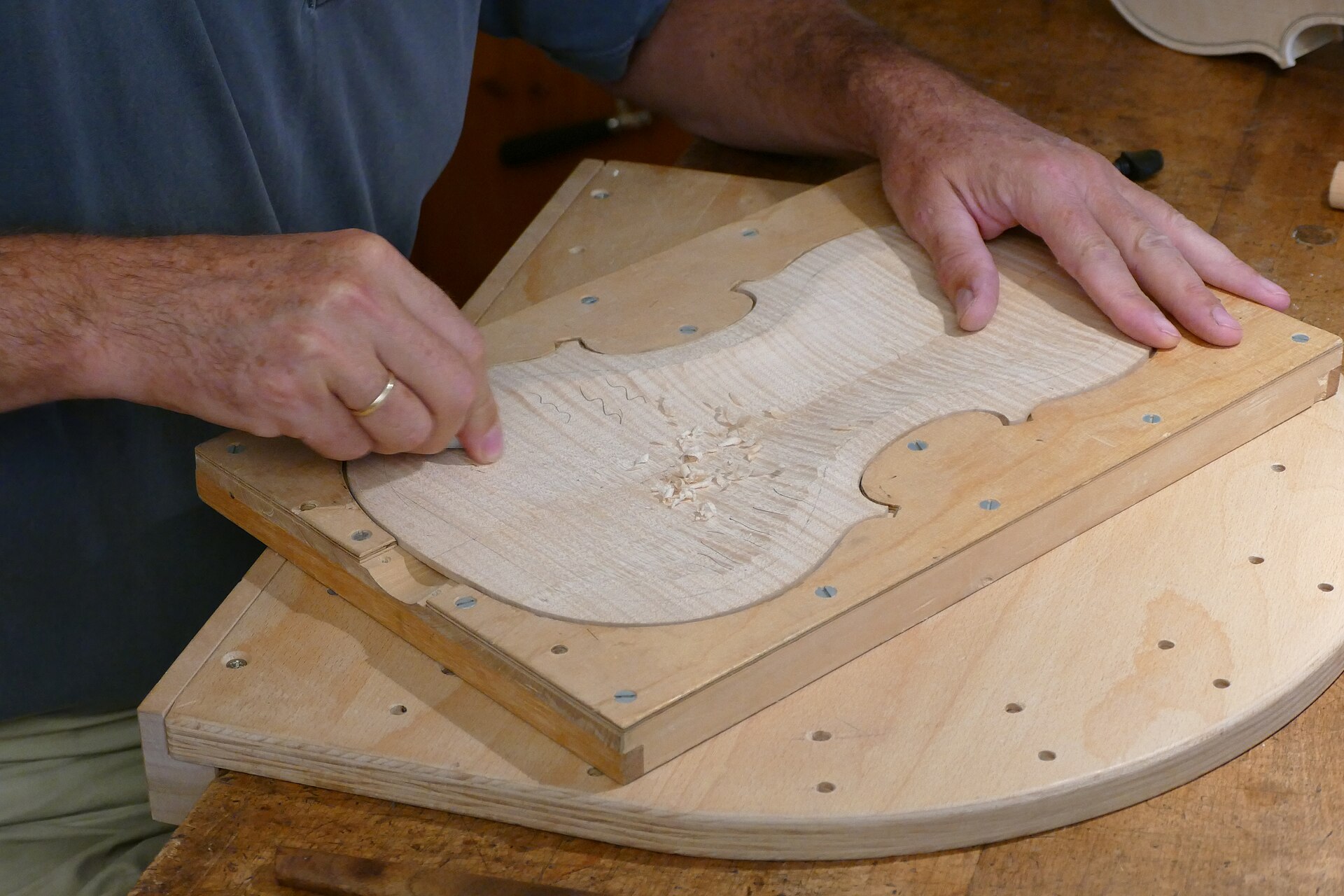
Connect the diagram to a real object
Franz Übelhör works on the inside of a violin back with a finger plane. This is a real example of shaping a plate’s thickness distribution; the photograph does not specify a target thickness.
Kritzolina · Wikimedia Commons · CC BY-SA 4.0
Article photographs retain their full proportions; covers show a cropped view.
h = 100%
m = 100% · EI = 100.0%
h = 90%
m = 90% · EI = 72.9%
Notice what changes
For a uniform strip, 10% less thickness removes 10% of mass when length, width and density stay fixed. No new material property has been created.
Understand why
Bending rigidity scales with thickness cubed. Keeping 90% thickness leaves only 72.9% of that rigidity. Frequency combines both rigidity and inertia, so it follows a different scaling again.
Connect it to wood and making
A carved arched violin plate is not a uniform ruler. Thickness maps, arching, grain and assembly can redistribute motion; the strip teaches a mechanism rather than prescribing a final graduation.
Put names to the ideas
Mass and bending rigidity scale differently
For a uniform rectangular strip with fixed width and length, mass scales with h, while EI scales with h³. Removing a little thickness can therefore remove a larger proportion of bending rigidity.
Frequency is a combined result
The ideal strip has f ∝ h√(E′/ρ)/L². A frequency target alone cannot determine mass: different combinations of material and geometry can meet it.
Arching introduces another mechanism
An arched plate can couple bending and in-plane deformation. Thickness distribution, outlines, grain direction, bass bar, soundpost and assembly conditions change the resulting modes.
The symbol ∝ means “changes in proportion to” while other stated factors are fixed. Here mass follows h, bending rigidity h³, and ideal strip frequency h. These rules belong to the stated comparison.
A worked example
A 10% thickness reduction in the ideal uniform strip leaves 90% of mass, 72.9% of bending rigidity and 90% of its frequency. This scaling is not a carving prescription for a violin.
Explore it yourself
Compare material measurements before carving, then record the actual thickness map, arching and modal results after each controlled change.
- Thickness retained
- 90 %
- Bending rigidity retained
- 72.9 %