
Violin making · The sound chain
From bridge motion to radiated sound
Where does a material measurement stop explaining the violin?
The bowed string drives the bridge; the assembled body and enclosed air respond; surface motion radiates into the room. Each link adds information beyond a blank’s material indices.
Start with something familiar
A loudspeaker is not described by the material of its cone alone: a motor drives it, the structure moves and the air carries sound. A violin has a different mechanism, but also a chain from input to motion to radiation.
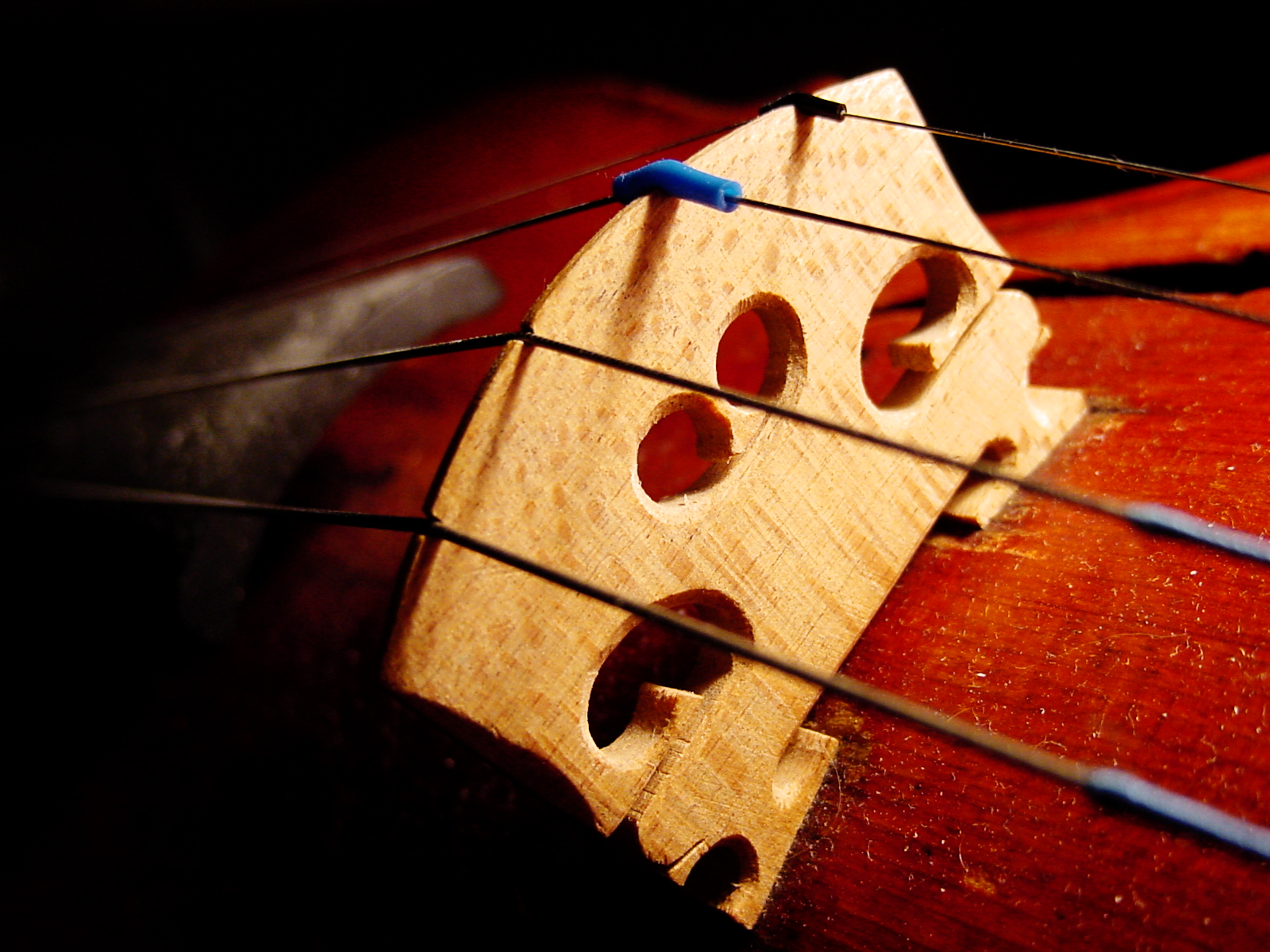
Connect the diagram to a real object
Follow the real contacts: strings meet the bridge crown, then the bridge feet meet the top. The bridge couples string motion to the body. This individual bridge is an example, not a standard shape or a graduation template.
Adam Shaylor · Wikimedia Commons · CC BY-SA 2.0
Article photographs retain their full proportions; covers show a cropped view.
Input and coupled structure
Bowing → bridge → body and air
Radiation and listening
Surface motion → air → room → listener
Notice what changes
The bowed string supplies a time-varying force through the bridge. That bridge is not a passive label; its motion is coupled to both string and body.
Understand why
The body and enclosed air respond through many modes. Surface motion must then radiate into the surrounding air; not every strongly moving pattern radiates equally well.
Connect it to wood and making
The player, setup, room and listener add further conditions. A material comparison is only one controlled piece of this chain, not a shortcut to predicting a complete recorded timbre.
Put names to the ideas
Input response at the bridge
Bridge mobility Y(ω) = v/F describes velocity per input force at a specified location and direction. It includes resonances of the coupled assembly and can feed back on bowed-string motion.
Motion is not sound pressure
Different surface regions contribute with frequency-dependent phase and amplitude. Radiation, microphone position and the room determine how structural motion becomes a recorded pressure spectrum.
Listening adds another layer
Player technique, bowing conditions, loudness and listening task influence perceived differences. A material correlation needs paired records and controlled comparisons before it becomes a claim about tone.
v/F asks how much bridge velocity a unit force produces. p/F asks how much pressure at a listening point the same force produces. They answer different questions and both depend on frequency.
A worked example
The same wood can be carved into different thickness maps, fitted with different bridges and adjusted with different soundpost settings. The resulting frequency responses need not match.
In practice
When studying finished instruments, pair material IDs with geometry, setup, controlled recordings and listening conditions; keep those observations separate from a material score.