
Material mechanics · Three dimensions
Wood directions and three-dimensional elasticity
Can one elastic modulus describe a piece of wood?
Wood responds differently along its grain, radially and tangentially. Follow the three-dimensional form of Hooke’s law to see how these directions are connected.
Try the interactive demoStart with something familiar
A bundle of straight drinking straws is much harder to stretch along the straws than to squeeze sideways. Wood is not a bundle of straws, but its elongated cellular structure helps explain why direction matters.
Connect the diagram to a real object
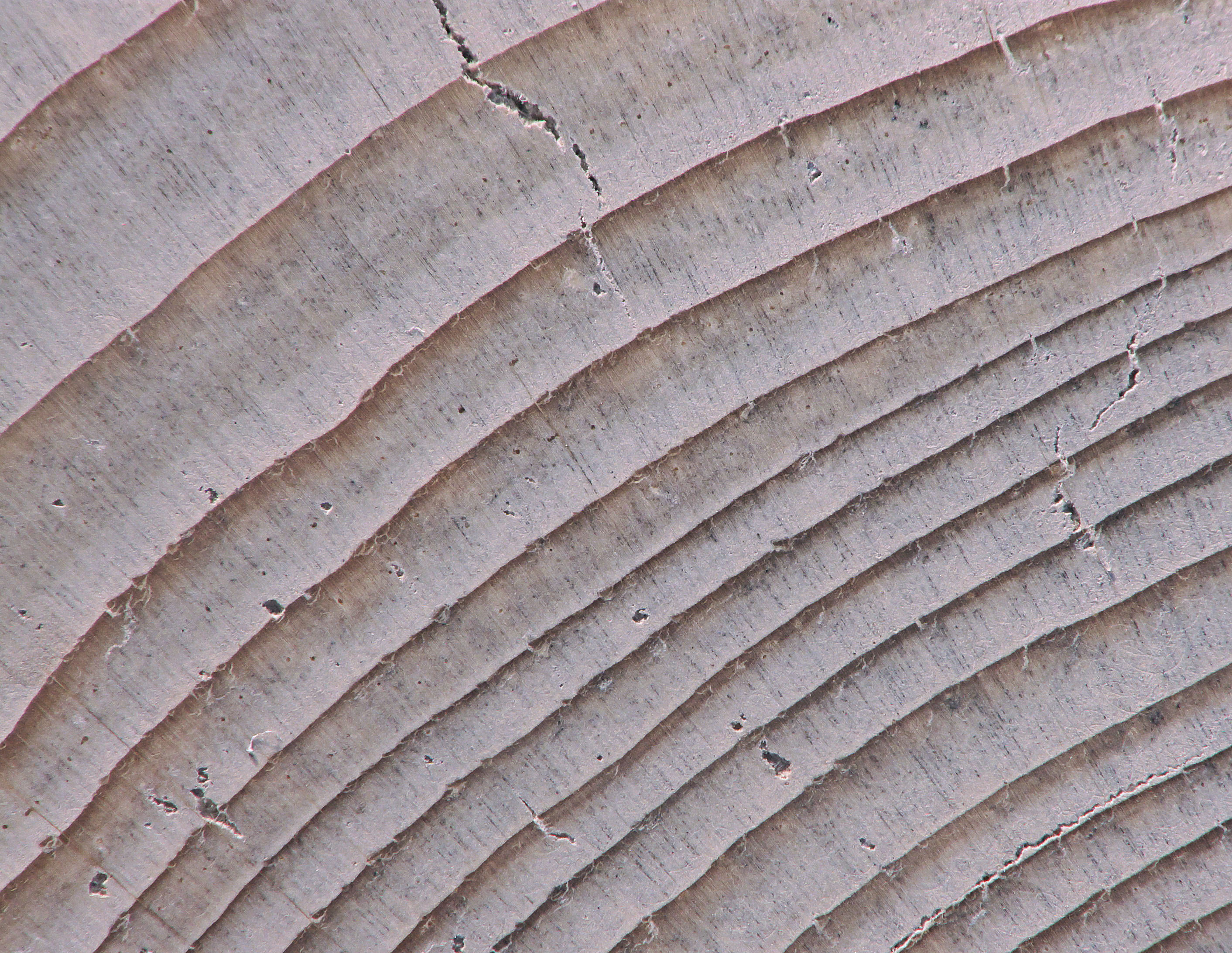
Find the curved growth-ring bands in this real spruce cross section. R runs across the rings; T follows their local tangent; L points out of this section along the grain. Ring appearance alone does not determine modulus or Q.
Rasbak · Wikimedia Commons · CC BY-SA 3.0
Article photographs retain their full proportions; covers show a cropped view.
Along the grain · L
Fibres run mostly along this direction
End grain · R and T
R crosses rings; T follows a local tangent
Notice what changes
Locate the grain first. L follows the fibres. In the cut end, R points across the growth rings toward or away from the tree centre; T follows a ring locally.
Understand why
Pulling, squeezing and shearing are different actions. A complete linear-elastic description must say how each load changes shape, including how one direction influences another.
Connect it to wood and making
A single longitudinal tap does not measure all of these responses. For plate models, the transverse and shear properties may also matter; identify which quantities were measured and which were assumed.
Put names to the ideas
Three material directions
L follows the grain, R is radial to the growth rings, and T is tangential to them. State the direction when comparing elastic moduli.
From a tensor to a matrix
The fourth-order compliance tensor connects stress and strain. Stress and strain symmetry allow a 6 × 6 matrix representation; elastic-energy symmetry leaves 21 independent constants in the general case.
Nine independent constants
In the orthotropic approximation, wood has three Young’s moduli, three shear moduli and three independent Poisson ratios. A longitudinal modulus describes one part of this response.
The tensor equation is a compact map from deformation to stress. The sequence 81 → 36 → 21 → 9 means that symmetry removes repeated or forbidden terms. You do not need tensor algebra to understand the three material directions.
A worked example
The progression counts tensor components after increasingly strong symmetry assumptions. The final nine describe orthotropic linear elasticity, not every possible response of real wood, such as moisture-induced change or damage.
Explore it yourself
Follow 81 → 36 → 21 → 9, select components and rotate the model. At the orthotropic stage, switch the loading direction to compare tensile and shear deformation.
THREE-DIMENSIONAL HOOKE’S LAW · LINEAR ELASTICITY
Hooke’s law for materials
Fourth-order compliance tensor: 3⁴ = 81 component positions.
Selected strain contribution